
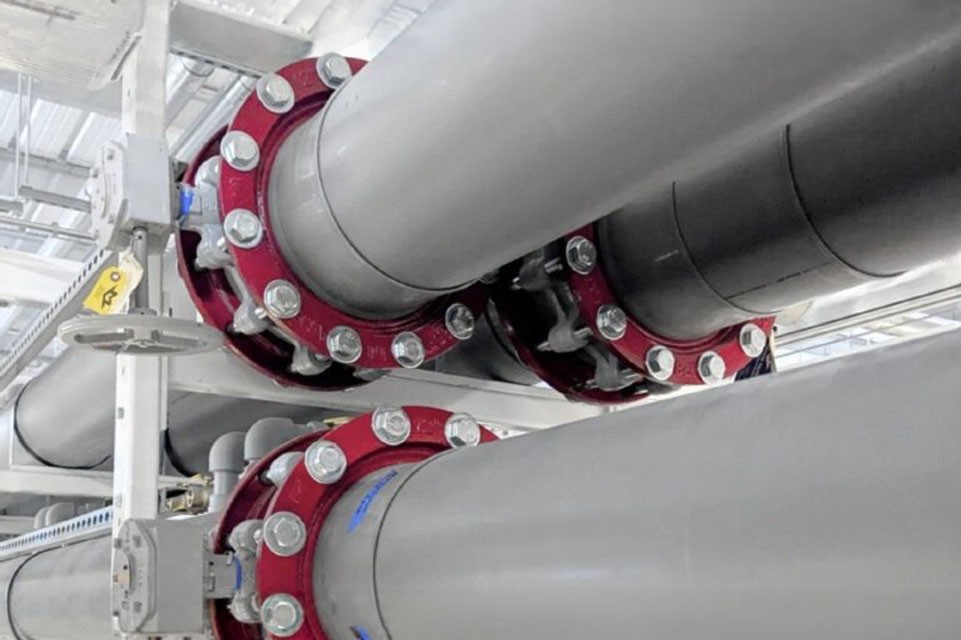
AI, high-density computing and growing rack loads are changing the way engineers approach data center cooling.
As more facilities move toward liquid cooling, the piping system becomes a critical part of the mechanical infrastructure. It has to reliably move large volumes of cooling water while supporting aggressive construction schedules, long-term efficiency and mission-critical uptime.
That is why engineers are increasingly considering PP-RCT (Polypropylene Random Copolymer with Modified Crystallinity) as an alternative to traditional metallic piping for mission-critical data center cooling systems.
For owners and engineers, the question isn't simply, "What pipe should we use?"
A better question is:
Which piping system gives us the best combination of reliability, constructability, lifecycle performance and cost?
For many liquid-cooled data center applications, PP-RCT makes a strong case.
What Is PP-RCT?
PP-RCT is an advanced polypropylene piping material designed for pressure piping applications.
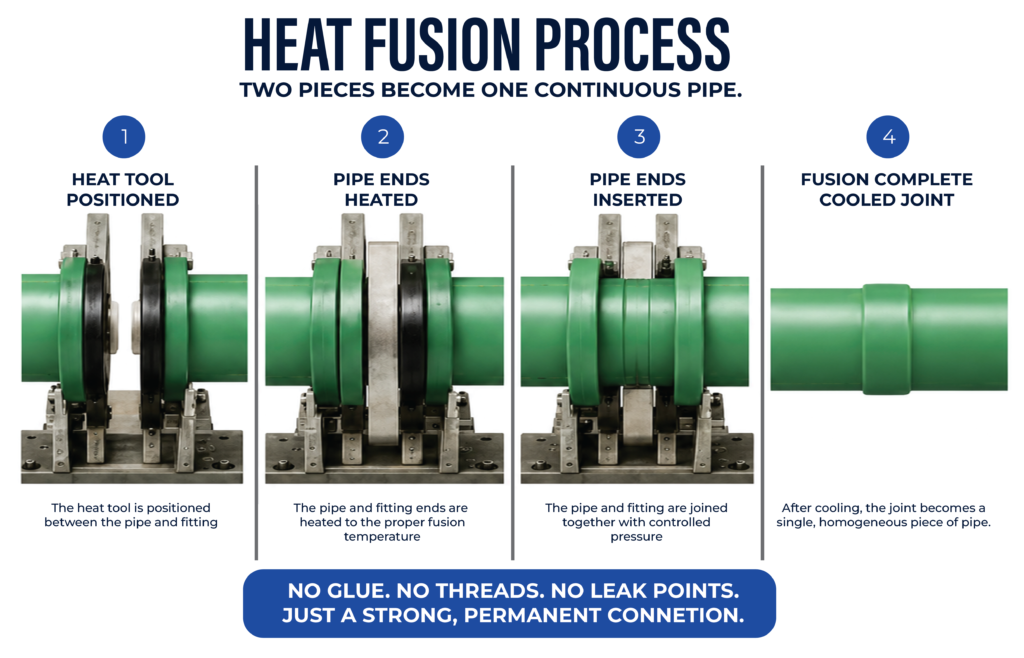
Unlike traditional steel or copper piping, PP-RCT is a thermoplastic system. Pipe and fittings can be joined using heat fusion, creating a homogeneous connection without relying on gaskets, adhesives or threaded joints.
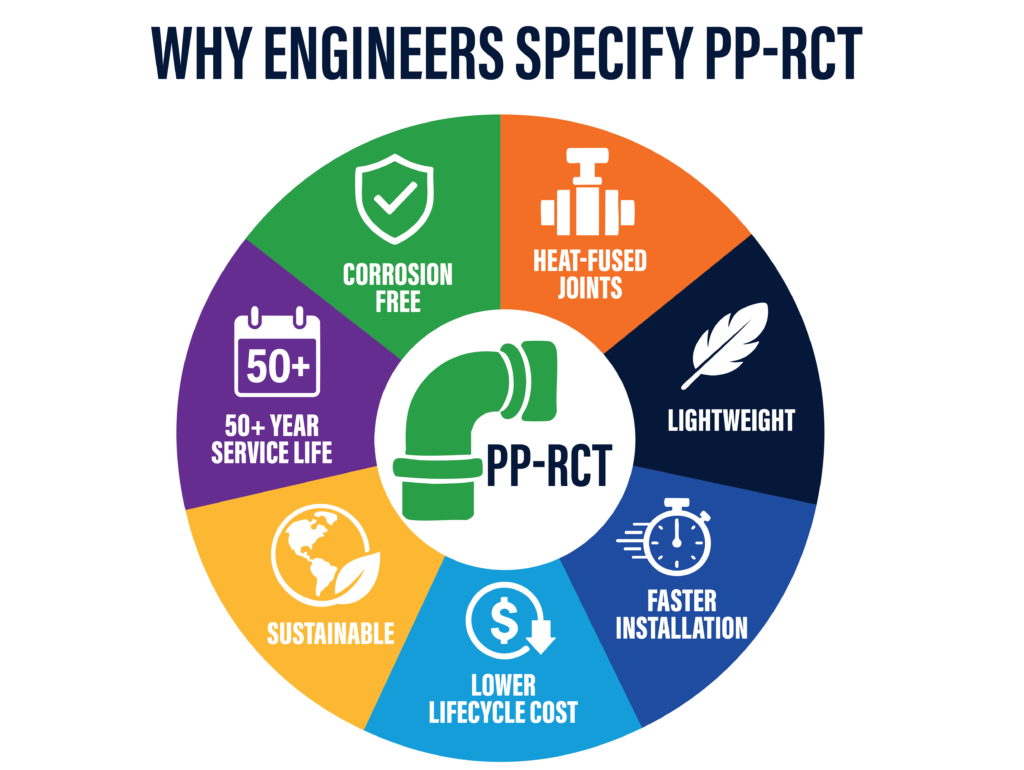
For data center cooling applications, its primary advantages include:
- Corrosion resistance
- Heat-fused joints
- Light weight
- Fast installation
- Smooth interior surfaces
- Low thermal conductivity
- Reduced maintenance requirements
- Long service life
- Compatibility with offsite prefabrication
These characteristics make PP-RCT particularly interesting as data centers become larger, denser and more dependent on liquid cooling.
Why Piping Material Matters More in Liquid-Cooled Data Centers
Piping has always been important to HVAC design, but liquid cooling raises the stakes.
AI and high-performance computing are increasing rack densities and cooling loads. That means cooling infrastructure may need to accommodate greater flow while operating reliably around extremely valuable electronic equipment.
The piping system affects more than water delivery. It can influence:
- Pumping requirements
- Cooling efficiency
- Water quality
- Construction schedules
- Structural requirements
- Leak risk
- Maintenance
- Future expansion
- Lifecycle cost
For engineers, selecting piping should therefore be considered as part of the complete hydronic system design.
1. PP-RCT Eliminates Corrosion
Corrosion is one of the most significant differences between PP-RCT and traditional metallic piping.
PP-RCT does not rust.
That matters in a closed-loop cooling system because corrosion products can affect more than the pipe itself. They can potentially contribute to fouling or contamination elsewhere in the system.
Maintaining cleaner piping surfaces can help protect:
- Heat exchangers
- Pumps
- Control valves
- Strainers
- Instrumentation
- Other cooling-system components
For data center owners thinking in terms of decades rather than the initial construction period, eliminating corrosion from a major portion of the cooling loop can be a significant lifecycle advantage.
2. Heat-Fused Joints Help Reduce Leak Risk
Leaks are a concern in any mechanical system.
In a data center, the consequences can be much greater.
PP-RCT uses heat fusion to join the pipe and fittings. During fusion, the materials are heated and joined to create a homogeneous connection.
That means the joint does not depend on:
- Gaskets
- Adhesives
- Threads
- Solder
- Traditional mechanical connections
When properly installed, the fused joint essentially becomes part of the piping system.
For mission-critical cooling infrastructure, reducing the number of potential mechanical failure points is an important design consideration.
3. Lighter Pipe Can Simplify Construction
PP-RCT is significantly lighter than traditional steel piping.
That can make a meaningful difference on large data center projects with extensive cooling-water distribution systems.
Lighter piping can help contractors:
- Move material more easily
- Reduce material-handling requirements
- Install overhead piping more efficiently
- Reduce lifting-equipment requirements
- Work with smaller installation crews
- Potentially simplify structural support requirements
Those advantages become even more valuable when construction schedules are aggressive and skilled mechanical labor is limited.
4. Faster Installation Can Help Protect the Project Schedule
For data centers, time to operation matters.
Piping installation can represent a significant amount of mechanical construction labor, particularly on facilities with large chilled-water and liquid-cooling systems.
PP-RCT's lighter weight and fusion joining methods can help accelerate installation compared with many traditional metallic systems.
It is also well suited to prefabrication.
Piping assemblies can be coordinated, fabricated and tested offsite while other construction work continues at the data center.
Once delivered, crews can focus more of their effort on positioning and connecting assemblies rather than fabricating every component in the field.
This parallel approach can help reduce onsite labor and improve schedule predictability.
5. PP-RCT Can Reduce Total Installed Cost
Engineers shouldn't evaluate piping based on material price alone.
The more meaningful number is total installed cost.
Depending on project requirements, PP-RCT can provide savings through:
- Reduced installation labor
- Faster installation
- Lower material-handling requirements
- Reduced heavy equipment requirements
- Simplified support systems
- Prefabrication
- Reduced hot work
- Lower long-term maintenance requirements
Material costs will vary by project, pipe size and system requirements. The appropriate comparison should consider the complete installed system rather than simply comparing cost per foot of pipe.
6. Eliminating Hot Work Can Reduce Construction Risk
Traditional welded steel piping introduces hot work into the construction process.
That can require additional:
- Permitting
- Fire watches
- Safety procedures
- Ventilation
- Coordination
- Labor
Fusion joining PP-RCT does not involve an open flame.
That can simplify installation, particularly when expanding or modifying an operating facility where controlling construction activity is especially important.
Reducing hot work can also make prefabrication and phased data center expansion easier to coordinate.
7. Smooth Interior Surfaces Support Hydraulic Performance
Piping isn't just a structural component. It is part of the hydraulic system.
PP-RCT has a smooth interior surface and does not rust.
Maintaining a smooth internal pipe surface over time can help preserve hydraulic performance and reduce the potential for corrosion-related restrictions.
That matters because changes in system resistance can affect:
- Pump operating points
- Energy consumption
- Flow
- Heat-transfer performance
- Overall cooling efficiency
GA Fleet works extensively with pumping and hydronic systems, so we look at piping and pumps as parts of the same system.
Good pump selection starts with understanding the system curve. Maintaining predictable piping characteristics can help the pumping system continue operating closer to the conditions engineers intended.
8. Lower Thermal Conductivity Can Benefit Chilled-Water Systems
PP-RCT has lower thermal conductivity than metallic piping.
For chilled-water applications, that can help reduce unwanted heat transfer through the piping wall.
Depending on the system design, operating temperature and environmental conditions, this characteristic may also help reduce condensation potential and insulation requirements.
Insulation requirements should always be evaluated for the specific application, but the thermal characteristics of the piping material are worth considering during system design.
9. PP-RCT Works Well With Prefabrication and BIM
One of PP-RCT's biggest advantages for modern data center construction may be how well it fits into a prefabricated project delivery strategy.
BIM and 3D modeling allow project teams to coordinate piping with:
- Pumps
- Valves
- Structural steel
- Electrical infrastructure
- Cable trays
- HVAC equipment
- Controls
- Other mechanical systems
Once coordinated, piping assemblies can be fabricated offsite in a controlled environment.
That gives teams an opportunity to identify clashes before fabrication, improve quality control and reduce the amount of work that has to happen at the data center.
For owners building multiple facilities, prefabrication also creates opportunities to standardize assemblies and repeat proven designs across projects.
10. Think About Pumps and Piping as One System
One of the biggest mistakes in mechanical system design is evaluating individual components without considering how they interact.
The piping system directly affects the pump.
Engineers need to consider:
- Design flow
- Total dynamic head
- Pipe velocity
- Friction loss
- Pump efficiency
- Variable-speed operation
- Redundancy
- Water chemistry
- Operating temperature
- Future expansion
Pipe sizing should balance initial cost against pumping energy and long-term performance.
Undersized piping can increase velocity and friction loss, requiring more pumping energy. Oversizing can unnecessarily increase material costs and system volume.
The best solution comes from evaluating pumps, piping and controls as one integrated hydronic system.
That's an area where GA Fleet can add value.
Our teams have decades of experience working with consulting engineers and contractors on pumps, HVAC, controls and packaged mechanical systems throughout the Northeast.
11. Design for Maintenance Before Construction
Data center cooling infrastructure needs to operate long after the construction team leaves.
That makes maintainability another important consideration when comparing piping systems.
Engineers should ask:
- How will pumps be isolated for service?
- Can critical valves be reached?
- Is there enough clearance to remove equipment?
- Can sections of the system be isolated without shutting down critical cooling?
- How easily can future piping be added?
- Has redundancy been incorporated where needed?
GA Fleet and Fleet Pump & Service Group support mechanical systems from initial design and startup through ongoing maintenance and repair.
That lifecycle experience gives us a simple perspective:
A good mechanical system isn't just easy to install. It should also be easy to operate and maintain.
12. PP-RCT Can Support Sustainability Goals
Data center sustainability isn't limited to electricity and water consumption.
The materials used to construct the facility also matter.
PP-RCT can contribute to sustainability objectives through characteristics including:
- Recyclability
- Lighter weight for transportation
- Reduced corrosion-related replacement
- Lower maintenance requirements
- Long service life
These lifecycle considerations can complement broader strategies to reduce energy consumption and improve the environmental performance of data center infrastructure.
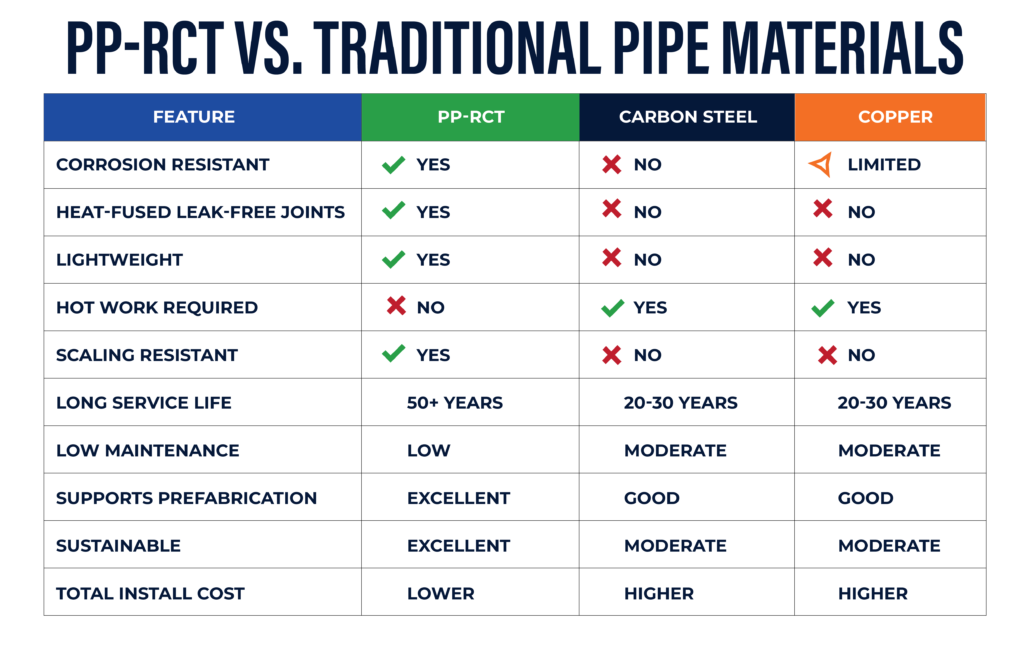
Why PP-RCT Is Especially Relevant for AI Data Centers
AI infrastructure is changing the scale of the cooling challenge.
Higher rack densities increase heat loads. Greater cooling requirements can increase water flow. Expansion needs can change quickly.
That puts more pressure on the mechanical infrastructure supporting the data center.
Engineers need cooling systems that can be:
Reliable. Scalable. Efficient. Fast to build. And practical to maintain.
PP-RCT's combination of corrosion resistance, fused joints, light weight and compatibility with prefabrication makes it a strong option for these increasingly demanding applications.
Local Mechanical Expertise Backed by National Data Center Resources
GA Fleet has been supporting complex pumping, plumbing, HVAC and water systems for more than 60 years.
Our teams work with consulting engineers and contractors from system design and equipment selection through installation, startup and aftermarket service.
Through the Vessco Water network, GA Fleet customers can also access specialized data center cooling and PP-RCT capabilities from sister companies, including:
- PP-RCT piping systems
- Prefabricated piping assemblies
- Liquid cooling pipe skids
- Pump skids
- Valve stations
- BIM coordination
- Hydraulic calculations
- Mechanical engineering support
- Factory fabrication and testing
- Startup assistance
- Field technical support
This gives engineers working with GA Fleet access to local pumping and HVAC expertise backed by a broader network of data center cooling, piping, water treatment and controls resources.
Choosing Piping Is a Lifecycle Decision
There isn't one piping material that is right for every application.
Engineers need to consider temperature, pressure, flow, water chemistry, code requirements, installation conditions and owner standards before specifying a system.
But for many liquid-cooled data center applications, PP-RCT deserves serious consideration.
Its combination of corrosion resistance, heat-fused joints, low weight, hydraulic performance, prefabrication potential and long-term maintainability addresses many of the challenges engineers face when designing today's mission-critical cooling systems.
Planning a liquid-cooled data center project in the Northeast? Talk to GA Fleet about your pumps, piping and hydronic system requirements and how the expanded capabilities of the Vessco Water network can support your project from design through startup and long-term operation. Call 914-835-4000.
Frequently Asked Questions About PP-RCT for Data Centers
What is PP-RCT piping?
PP-RCT stands for Polypropylene Random Copolymer with Modified Crystallinity. It is a thermoplastic pressure piping material used in HVAC, plumbing and other hydronic applications. PP-RCT systems use heat-fused connections that join pipe and fittings into a homogeneous piping system.
Why is PP-RCT used in liquid-cooled data centers?
PP-RCT offers several characteristics that are attractive for mission-critical cooling systems, including corrosion resistance, heat-fused joints, light weight, smooth interior surfaces and compatibility with offsite prefabrication. These features can help reduce installation time and long-term maintenance requirements.
Does PP-RCT piping corrode?
No. Unlike carbon steel, PP-RCT does not rust. This can help maintain cleaner internal piping surfaces and reduce corrosion-related contamination within cooling-water systems.
How are PP-RCT pipes joined?
PP-RCT piping is typically joined using heat-fusion methods. The pipe and fitting surfaces are heated and joined so they form a homogeneous connection. The exact fusion method depends on pipe size, fittings and manufacturer requirements.
Can PP-RCT reduce leak risk?
Properly installed heat-fused PP-RCT joints do not rely on gaskets, adhesives or threaded connections. Eliminating these mechanical joint components can reduce potential leak points within a piping system.
Is PP-RCT lighter than steel?
Yes. PP-RCT is considerably lighter than steel piping. The lower weight can simplify material handling, overhead installation and prefabrication and may reduce some lifting and structural support requirements.
Can PP-RCT lower data center construction costs?
Potentially. Engineers should compare total installed cost rather than material price alone. PP-RCT can provide savings through reduced labor, faster installation, easier material handling, simplified supports and offsite prefabrication. Actual savings depend on the individual project.
Can PP-RCT be prefabricated?
Yes. PP-RCT is well suited to offsite fabrication. Piping assemblies and skids can be coordinated using BIM, fabricated in a controlled environment and delivered to the data center ready for installation.
How does PP-RCT affect pump selection?
The piping material, pipe diameter, length, fittings and system configuration all contribute to friction loss and total dynamic head. Engineers should evaluate the PP-RCT piping system together with pumps, controls and operating conditions to optimize overall hydronic performance.
Is PP-RCT appropriate for chilled-water systems?
PP-RCT can be used in many chilled-water and hydronic applications when the selected pipe system meets the project's temperature, pressure and code requirements. Engineers should verify system ratings and manufacturer requirements for each application.
How long does PP-RCT piping last?
Service life depends on system temperature, pressure, design, installation and operating conditions. PP-RCT manufacturers commonly design systems for long-term operation, and engineers should consult the selected manufacturer's pressure-temperature ratings and lifecycle data for the specific application.
Does GA Fleet provide PP-RCT piping systems?
GA Fleet provides pumping, HVAC, controls and mechanical-system expertise throughout the project lifecycle. Through the Vessco Water network, GA Fleet customers can also access specialized PP-RCT piping, engineering, BIM, prefabrication and liquid-cooling capabilities for data center projects.